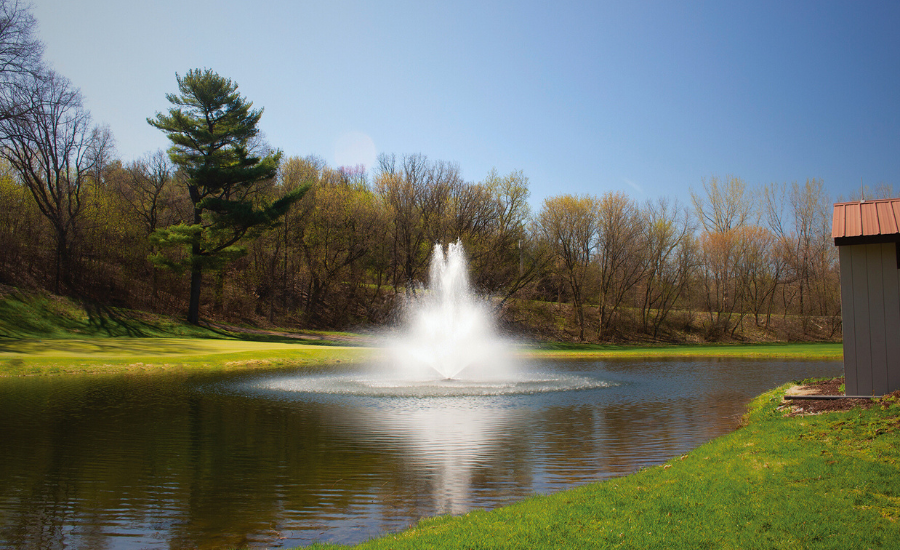

Fountain or Aerator for a Pond – Which Is Better?
When researching pond aeration, you’ll often see conflicting advice, especially around choosing between a fountain or a diffuser/bubbler.
The truth is, both systems aerate water, but they do so in different ways, excel in different pond environments, and solve different problems. Asking “which is better?” will yield entirely different answers depending on your pond and the results you want.
This guide breaks down each system so you can confidently choose what works best for your pond.
SECTION 1 — All About Fountains

* Pictured: The Scott Aerator DA-20 Aerating Fountain - Click Here For Details
Fountains Do Aerate (Clearing Up The Misconception)
By definition, aeration is the process of introducing oxygen into a material, in this case, the water in your pond.
The vast majority of oxygen transfer in ponds occurs at the surface. A fountain sprays water high into the air and spreads it over a wide area. As this oxygen-rich water falls back into the pond, it penetrates the surface layer where most oxygen exchange happens, directly increasing dissolved oxygen levels in the water. Looking at how a fountain works and comparing it with the definition of aeration, it’s clear that fountains are not just decorations.
Fountains also provide other practical benefits, they:
-
Quickly break up surface scum and algae mats, improving pond clarity
-
Reduce mosquito breeding by keeping the surface moving
- Create an appealing display that enhances a ponds overall appearance
The main limitation? Fountains primarily aerate and circulate from the surface downward, so their effectiveness diminishes in greater depths. In shallow ponds (roughly 8 ft or less), a properly sized fountain can provide adequate circulation and oxygenation even in the deep zones. In deeper ponds (more than 8 ft), circulation will be diminished, but fountains still provide excellent surface aeration in any case.
How Fountains Work (Top-Down Aeration)
Fountains move water from the surface downward. Their strengths include:
-
High oxygen transfer at the surface
-
Circulation of a broader area at the top layer
-
Minimal disturbance of deep sediments
- Quick disruption of surface algae and scum
When Fountains Are the Better Choice
A fountain may be right for your pond if many of these are true:
-
Your pond is shallow (up to 8 ft deep)
-
Surface issues (algae, clarity, mosquitoes) are your primary concern
-
You want both aeration and an attractive water feature
-
You want to directly increase oxygen levels in the pond
Additional Considerations for Fountains
-
Older Ponds: Fountains are generally low-risk for disturbing bottom sediments, this means they can run 24/7 from the start without the risk of a fish kill. Very high-flow units may still require monitoring.
-
Different Types of Fountains: Aerating fountains with a propeller move large volumes of water efficiently. Decorative fountains can also aerate effectively but require more horsepower to achieve similar circulation and oxygenation.
-
Energy Use: Fountains historically used more power, but modern high-efficiency models have come a long way and can consume similar energy to some diffuser systems.
-
Electricity in the Water: Fountains require submerged power, but reputable brands meet safety standards. Using a GFCI and standard precautions ensures safe operation.
SECTION 2 — All About Diffusers/Bubblers

* Pictured: The Scott Aerator Bubble-Pro Diffused Aerator - Click Here For Details
What Diffusers Actually Do (Bottom-Up Aeration)
Diffusers sit on the pond bottom and release rising columns of air bubbles. These bubbles lift oxygen-depleted bottom layers of water toward the surface, mixing it with oxygen-rich top layers. Diffusers are great for:
-
Full-column circulation and destratification
-
Maintaining oxygen & temperature throughout the water column
-
Reducing dead zones in deeper ponds (>8–10 ft)
Unlike fountains, diffusers aerate more indirectly. Only a small portion of oxygen actually dissolves and is introduced into the water from the bubbles (roughly 1–12%, depending on the pond depth and bubble size); the main purpose of a diffuser is mixing oxygen-rich surface water with deeper layers over time.
This slower, whole-column aeration helps maintain consistent circulation and oxygen levels throughout very deep ponds. But, the gentle and localized disturbance created at the surface means it will take longer to dissipate surface algae and does not increase oxygen directly like a fountain or surface aerator.
Special Considerations for Diffusers
-
Older or Deep Ponds: Because diffusers sit at the bottom, they can disturb deep sediments which can quickly result in a fish kill. Run 15–30 minutes the first few days, then increase slowly.
-
Shore-Based Equipment: The compressor sits on land, avoiding electricity in the pond. Many pond owners prefer this for safety and convenience.
When Diffusers Are the Better Choice
A diffuser may be right for your pond if many of these are true:
-
Your pond is deeper than ~8 ft
-
Full-depth circulation and destratification are priorities
-
You want minimal surface disturbance and a natural appearance
-
You are patient for surface algae to dissipate
Best Option For Deep Ponds? Using Both Systems Together
In many deep ponds, the ideal setup combines both:
-
Diffuser: Moves water from bottom to top, maintaining oxygen & temperature throughout the water column
-
Fountain: Provides rapid surface oxygenation, breaks up surface scum, and adds a visually appealing water feature
Together in a deep pond, they maximize circulation, oxygenation, and pond clarity more than either system alone. This combination is especially effective for:
-
Complete destratification and full-column circulation
-
Strong oxygen transfer at the surface
-
Breaking up algae and reducing odors
-
Discouraging mosquito breeding
-
Maintaining a visually appealing pond feature
Conclusion
The fountain vs. diffuser debate is rooted in a lot of misconceptions. Both are effective aeration tools, each excelling in different scenarios:
-
Diffusers: Best for deep ponds and full-column circulation
-
Fountains: Best for surface aeration, algae disruption and shallow ponds
Understanding why you want aeration and the strengths and limitations of each system makes choosing the right option straightforward.