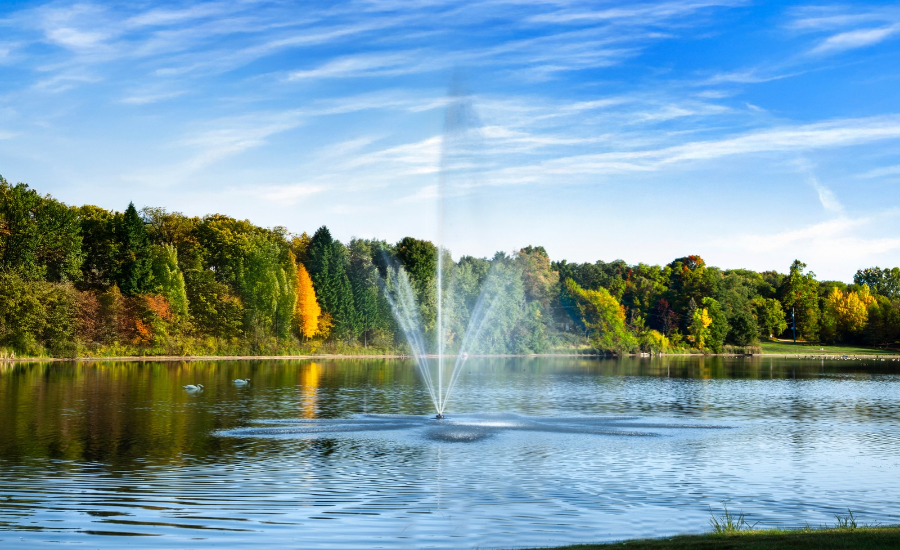


Are Pond Fountains As Good As Aerators?
One of the most common misconceptions about pond fountains is that they're only decorations, and that if you are concerned about pond health you need a bottom-up aerator. This notion is largely false, with some caveats.
A fountain system is perfectly adequate for aerating many ponds. There are a few factors which really influence how well they will perform, such as their design, size, and the characteristics of the pond itself. If these criteria are met, they can provide a large amount of oxygen transfer, promote circulation, and help maintain overall healthier water conditions.
Bottom-diffused aeration systems do offer some real advantages, particularly in deeper ponds where maintaining circulation throughout the entire water column becomes increasingly important.
However, having a proper understanding of how these systems work, what they accomplish, and where each performs best can help you determine which solution makes the most sense for your pond.

How Does A Pond Fountain Aerate?
A pond fountain works by drawing water from the pond and projecting it into the atmosphere through a spray pattern.
As this atomized water falls back into the pond, it comes into contact with atmospheric oxygen. This creates a direct interaction between the water in the pond and the air outside of it, allowing meaningful amounts of oxygen to be introduced into the pond.
However, it's important to distinguish between a fountains ability to introduce oxygen into the water and the ability to distribute that oxygen evenly throughout the entire water column.
A fountain primarily interacts with the upper portions of the water column, losing effectiveness in depths of around 8 to 10 feet.

So When Is A Bottom Diffused Aerator Better?
A bottom-diffused aeration system operates much differently.
Instead of pumping water into the air, a compressor located on the shoreline pushes air through tubing to one or more diffusers positioned underwater.
The diffusers release small bubbles that rise through the water column.
As these bubbles rise, they create an upward current that carries surrounding water toward the surface. This movement helps circulate water from the deepest portion of the pond.
Some oxygen does transfer directly from the bubbles into the water, but the primary benefit of bottom-diffused aeration is its ability to promote circulation of the entire water column. This is particularly important in ponds with an average depth of 8 to 10 feet or more.

So Which Provides Better Aeration?
There isn't a universal winner. The answer depends on what you mean by aeration, what you're trying to accomplish, and the overall depth of your pond.
If the primary objective is directly increasing oxygen levels, then a properly sized fountain is highly effective, particularly in ponds with an average depth of 8 feet or less.
If the goal is circulating deeper water and maintaining more uniform conditions throughout the entire water column, bottom-diffused aeration clearly has the advantage.
These are related objectives, but they aren't interchangeable.
Not All Pond Fountains Stack Up The Same
When selecting a pond fountain for aeration, it is important to consider how much water the fountain moves, rather than how high it sprays.
A decorative fountain that produces a tall, narrow spray pattern may look impressive, but a fountain that moves significantly more water will provide greater aeration.
Aerating pond fountains feature wide, V-shaped spray patterns, along with propeller driven pumps. These fountains are specifically engineered to maximize water movement, atmospheric exposure, and surface turbulence rather than simply achieving the tallest possible display.
When shopping for a pond fountain with aeration in mind, pay particular attention to its water flow rate, typically measured in gallons per minute (GPM) or gallons per hour (GPH).
What Is the Best Pond Fountain for Aeration?
One of the best examples of a high-performance aerating pond fountain is the Scott Aerator DA-20 Aerator Fountain.
Unlike conventional decorative fountains, the DA-20 is specifically engineered to maximize water movement and aeration while still providing an attractive fountain display.
In its larger horsepower configurations, the DA-20 is capable of moving upwards of 40,000 gallons of water per hour. It is available in multiple horsepower options, making it suitable for ponds ranging from approximately 1/8 acre to 3 acres in size.
Its exceptional water-moving capabilities make it an excellent choice for pond owners looking to improve water quality without sacrificing the visual appeal of a fountain.
In Summary
A properly sized pond fountain is in fact an aeration system, not simply a decoration.
For many ponds that have an average depth of 8 to 10 feet, a properly sized pond fountain can easily serve as the sole aeration system. For deeper ponds, a bottom diffused aerator is usually more appropriate or can serve as a helpful addition.
Ultimately, choosing the right equipment comes down to understanding the specific needs of your pond.
At PondStream, we specialize in helping pond and lake owners find the right fountain for their application. Explore our selection of pond fountains or contact a member of our team for personalized assistance.